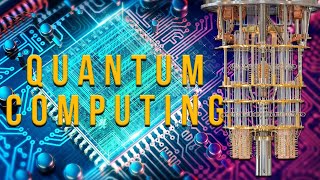
 Hi, thanks for tuning into Singularity Prosperity. This video is the ninth in a multi-part series discussing computing and the second discussing non-classical computing. In this video, we'll be discussing what quantum computing is, how it works and the impact it will have on the field of computing. The foundation of this paradigm shift in computing is the quantum bit, qubit for short, as the unit of measurement for quantum information.
While a classical binary digit, bit, can only be either 0 or 1, a qubit can be both 0 and 1 due to superposition. Superposition is a property of quantum mechanics in which when not measuring a system, the resultant can be a variety, more specifically, a probability of two or more states. However, when we measure the system, a final state must be adhered to. An example most people are familiar with is, Schrodinger's cat, both alive and dead in the box at the same time, until we open it up.
A more concrete example is the famous double slit experiment which showed the wave-particle duality of light. When firing electrons through a sheet with two slits, we'd expect that the particle would go through one slit or the other and produce light in-line with the slit on the wall behind it, and this is in fact what happens when we observe the result. However, when we're not observing, the electron produces light on the wall representative of an interference pattern, with an interference pattern being the result that would be seen if a wave, say of water, was to go through slits, with the constructive and destructive interference producing the same exact pattern as single electrons going through. With electrons however, the result on the wall is determined not by interference but by a Bayesian probability spread, the probability that we'd find the electron at a specific point on the wall, with higher probabilities in the center and getting lower as we move outwards.
In fact, the electron actually goes through both slits, and one slit, and the other slit, and no slits...All at the same time and produces this spread. Another property of quantum mechanics is entanglement, in which two or more particles can have correlated final states when measured. This meaning if one particle is measured have an upward spin for example, and if there is an other particle entangled with a negative correlation, then that second particle would have a downward spin. This is what Einstein referred to as, spooky action at a distance, you can create an entangled pair, move them across the universe and they would still instantaneously receive information about one another.
For more information on quantum mechanics, be sure to check out other creators on this platform such as, Frame of Essence. Moving on, now that we have a basic 'understanding' of quantum properties, how does this translate to quantum computers? To represent a qubit multiple avenues can be taken: the spin-up and spin-down states of an electron, the spin states of a nucleus in an atom and the polarization state of a photon. Both bits and qubits scale in the same way, 1 bit is equivalent to 2 potential states, 2 to 4, 3 to 8 and so on. However, with bits in classical computers, all those potential output states can only be computed one state at a time, serial operation.
In quantum computers, all states are effectively computed together, true parallel operation. As a side note, quantum bits are represented using a bloch sphere. With 0 and 1 only having a z-axis value and all the other superposition states with only an x and y-axis value. N qubits translates to 2^N parallel paths of execution, to highlight how important this is in terms of computing, watch this clip on the power of exponentials that IBM in fact played in the 1960s to highlight the power of computing performance: This is an old story, but it reminds us of the surprises we can get when even a small number like 2 is multiplied by itself many times.
King Sharam of India was so pleased when his Grand Vizier presented him with the game of chess, that he asked him to name his own reward. The request was so modest, but the happy King immediately complied. What the Grand Vizier had asked was this, that one grain of wheat be placed on the first square of the chessboard, two grains on the second square, four on the third, eight on the fourth, 16 on the fifth square and so on. Doubling the amount of wheat on each succeeding square until all 64 squares were accounted for.
When the King's steward had gotten to the 17th square the table was well filled, by the 26th square the chamber held considerable wheat and a nervous King ordered the steward to speed up the count. When 42 squares were accounted for the palace itself was swamped, now fit to be tied King Sharam learns from the court mathematician that had the process continued, the wheat required would have covered all India to a depth of over 50 feet. Incidentally, laying this many grains of wheat end-to-end also does something rather spectacular, they would stretch from the Earth, beyond the Sun past the orbits of the planets, far out across the galaxy to the star Alpha Centauri, four light-years away. They would then stretch back to Earth, back to Alpha Centauri and back to the Earth again.
So, after seeing the scale of parallel operations a quantum computer can do, how do quantum computers compute? Step One) Activate The Spread: The quantum bits required for the calculation are acquired and entangled. Visualizing this in a bloch sphere, these entangled bits are in an equal spread of the superposition of all the 2^N. States. Step Two) Encode The Problem: The problem is encoded onto the system via quantum gates which we'll discuss later in this video.
These gates reorient the qubits into new superpositions for all the 2^N states by altering their phase and amplitudes. Step Three) Unleash The Power: The quantum computer comes to a solution by using the principles of interference to magnify the amplitudes of the most probable answers and shrink the improbable answers. Some recursive problems will require running through the steps again. The final step draws parallels to the double slit experiment we discussed earlier, through interference patterns a Bayesian probability spread is produced, showing the likelihood of the most probable solutions, just like the probability spread showing where the light would be most likely to shine.
There are problems a classical computer simply can't solve, this is part of the P. Versus NP problem. Simply put, P versus NP. Is problems that could be solved in a reasonable amount of time versus problems that can never be solved or would take too long to obtain a solution.
One such problem is factoring a number into primes, this is called Shor's algorithm, which is also the basis of modern encryption. A classical computer would take in the order of quadrillions of years to solve an encryption problem without a key, going through each potential output sequentially. A quantum computer could solve this in the span of a few days or less due to parallel computation. A more in-depth discussion on quantum encryption and security is a topic best left for a future video on cyber security.
Also as a side note, if you want more information on the P. Versus NP problem, be sure to check out the best video on the topic by creator, hackerdashery. Back on topic, another huge problem set that quantum computers can solve and will drastically impact the world are optimization problems. Classical computers can do optimization problems up to a certain point, before a combinatorial explosion occurs.
This is the point where the number of different combinations that must be explored in a given problem grows exponentially. Take the optimal seating plan for 14 people at a banquet dinner for example. With 2 people there is 2! 'Factorial', in other words, 2 combinations, 3 people is 6 combinations, 4 24, 5 120, 6 720, 7 5040. As you can see, the problem is slowly reaching an exponential tipping point, now going forward by another seven people at 14 people there are over 87 billion different seating combinations.
This simplistic example serves well for visualizing the scale optimization complexity can reach, and how problems while simple at first can get out of reach for classical computers very fast. Now a field of computer science that has seen a lot of traction recently and aims to solve optimization problems is machine learning, further extending to artificial intelligence. These algorithms are able to solve problems previously thought not possible by the P versus NP. Problem.
We'll cover this topic very intensively in this channels AI series, but essentially machine learning algorithms solve problems by crawling through large sets of data and finding commonalities and correlations which help it form its own optimal solution rather than explicit programed code. Data crawling, sorting and path optimization are fields of computer science in themselves, with algorithms designed to reduce the time required, such as bubble sort, shear sort, Dijkstra and countless others. All these algorithms are classical in nature and even though some might implement asynchronous techniques, they are still serial, so a 1 million element list for example is still sorted element by element. Quantum computing algorithms as discussed in the previous section will be able to sort and optimize data much faster through their parallel operation, this translates to exponentially increasing AI performance.
From circuit design, the shape of vehicles for optimal drag performance, Google Maps, other complex P versus NP problems such as protein folding and simulating chemical reactions, the list can go on and on. Quantum computing algorithms and AI will revolutionize nearly every field from bio and nanotechnology to marketing to ideas we can't even imagine possible today - many videos on this channel will be dedicated to covering these ideas in the future. It is highly improbable we will see quantum computers on a desktop anytime soon, however, through the concept of heterogeneous system architecture which we discussed in a previous video in this computing series, there will still be ways we can get the benefits of quantum performance. One such method will be quantum computers in the cloud.
You access them with problems through your normal devices such as a desktop, laptop or mobile phone and quantum computers in the cloud will reduce the probability space, return the most probable answers and your device will have enough computing power to take it from there. Coming up we'll cover some quantum computers we'll see in the cloud in the near future and some that are already there now! [Music] 2018 is for quantum computing like 1968 was for our current classical computers: computers are the size of entire rooms, the cutting edge of all types of research is pouring into them and more organizations and people are entering the race to quantum supremacy every year. Quantum supremacy is the point at which quantum computers will become more powerful than classical computers, this milestone is set at 50 qubits. There is a difference however between the methodology of quantum computing used to get there, not all quantum computers are made equal.
Dwave for example uses a type of quantum computer based on quantum annealing, this allows them to scale up much faster in the qubits used: from 128 in 2011, 512 in 2013, 1000 in 2015, 2048 in 2017 and a 5,000 qubit system is expected this year, 2018. Quantum annealing however doesn't operate like a typical quantum computer and relies on energy minimization problems which lowers the scope of problems that it can solve. These problems are still in the NP. Section, and referred to as QUBO, quadratic unconstrained binary optimization, problems.
Essentially a pattern matching technique which also has applications that are useful in machine learning. It is hard to quantify when quantum annealing will reach a point of quantum supremacy due to its problem scope, however, this approach is the fastest to scale and will bring public quantum computing faster than gate based quantum computing. The 50 qubit quantum supremacy milestone is set for gate based quantum computing, this is what we discussed about earlier in the video, where all qubits in the system are entangled and a probability spread outputted. There are various initiatives to achieve this, to list a few: Intel with there 49 qubit chip unveiled at CES 2018, IBM with development of a 50 qubit chip announced late 2017, Google who have built a 50 qubit chip and are now testing and Rigetti who have plans for a 50 qubit chip by 2019.
For more information on current initiatives be sure to check out other creators on his platform, as the quantum race is ever-changing and expanding. Now to see how complex quantum computers are, check out this video of IBM's quantum computer, Q: This is the first IBM Q computation center, where the commercial quantum systems used by the IBM Q network live. The IBM Q network is a worldwide organization of industrial, research and academic institutions - joining IBM to advance quantum computing and launched the first commercial applications. Here we see a 20 qubits system which will be accessed online by members of the IBM Q network, in the future they will have access to 50 qubit systems which IBM recently prototyped.
Listen to the tinkling whoosh the system makes as it maintains the ultra-cold, 15 millikelvin temperature, required for IBM's superconducting qubits to operate. That's colder than outer space, cold enough to make atoms almost completely motionless. This is an open dilution refrigerator that contains the qubits of niobium, silicon and aluminum - it's so dark and cold inside, that it's almost impossible to find even one photon of light. The 20 qubit quantum computer you just saw is available for public use through IBM.
Cloud services, and has a great community of developers and people just venturing into learning quantum algorithms with many resources on what types of quantum gates there are and their effect on results. This system is global with over 60,000 users from more than 1,500 universities, 300 high schools and many institutions - running over 2 million experiments with over 35 research papers and growing. In fact, the first quantum video game has been created by one of these users, Quantum Battleships, you can hit miss and both at the same time ;)! Microsoft also has a development environment and extensive documentation for simulating a quantum computer and running quantum algorithms on your computer at home. This is a fairly computationally intensive process, with simulation correlated to your RAM.
Simulating 30 qubits requires 16 gigabytes of RAM, adding just one more qubit doubles the amount of RAM needed, one less halves the memory required - extrapolating forward, simulating 40 qubits requires 16 terabytes of memory, which is why there is also the ability to run simulations off Microsoft's Azure cloud! Commercial adoption of quantum computing is still a ways off, but as stated earlier, 2018 is the 1968 of quantum computers, with inevitability that they will be the basis for future computation. This field of computing is still in its infancy, but accelerating at an increasingly exciting and rapid pace! [Music] At this point the video has come to a conclusion, I'd like to thank you for taking the time to watch it. If you enjoyed it consider supporting me on Patreon to keep this channel growing and if you want me to elaborate on any of the topics discussed or have any topic suggestions please leave them in the comments below. Consider subscribing for more content, follow my Medium publication for accompanying blogs and like my Facebook page for more bite-sized chunks of content.
This has been an Ankur, you've been watching Singularity Prosperity and I'll see you again soon! [Music].

No comments:
Post a Comment