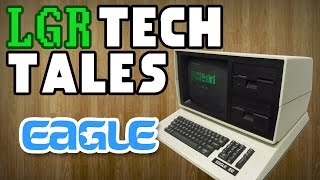
 [Music] In 1983, the newly-formed Eagle Computer, Inc.,
Was on the road to fast success in Silicon Valley. Building on their existing experience
with computers under another name, Eagle had not only one of the more
capable CP/M machines on the market, but a true IBM PC clone that
bested the machine it was cloning in a multitude of ways. And yet, despite high praise for their products, Eagle Computer was forced out of
business in just a few short years, due to a combination of lawsuits,
a botched public stock offering, and the aftermath of a crashed Ferrari. What happened? This is "LGR Tech Tales," where we take a look at noteworthy stories
of technological inspiration, failure and everything in between.
This episode tells "The Unfortunate
Tale of Eagle Computer." The story of Eagle begins not in 1970s Silicon Valley, but on the opposite side of the country
in 1970s Atlantic Highlands, New Jersey. Brothers Gary and Charles Kappenman started a
computer company called Audio Visual Laboratories, or AVL, with the goal of providing computerized
multi-image slideshow programmers. For a time, these were the state-of-the-art, using 35mm slides projected
by multiple slide projectors onto one or more screens in
synchronization with a voiceover or music track. AVL introduced the world's first microprocessor-
controlled multi-image programming computers the Show Pro III and V, which were dedicated controllers
that could not perform other tasks.
However, as the personal computer revolution
started taking off in the late-'70s, AVL put their hat into the ring by
building their first personal computer, the Eagle I, introduced in 1980 and becoming the first non-dedicated
multi-image programming controller. It boasted a 16 KHz processor, and a single-sided double-density 5" disk drive for easily transferring multi-image programs. But the hardware also allowed it to use
the number one operating system of its day, Digital Research's CP/M. With this additional capability, the Eagle line of computers became an industry standard for multi-image control equipment.
Popularity and demand was so high that AVL opened offices on the West Coast, and this is where they chose to spin off
their computer business as its own company, Eagle Computer, in May of 1982 in Los Gatos, California. Dennis Ray Barnhart, a former American fighter pilot who
survived being shot down TWICE in Vietnam, and had since become a
skilled Silicon Valley businessman, spearheaded this founding of Eagle, and was named president and chief executive officer. Under his direction, they built Eagle computers
that were essentially the same as AVL's. They simply removed the AV ports
and multi-image controller bits and replaced them with RS-232
serial and Centronics ports for connecting standard peripherals.
They also offered several pieces of
high-quality productivity software, namely "Eagle Calc" and "Eagle Writer," making it even more appealing. Eagles proved to be versatile, well-built and
attractive CP/M machines for professionals, with sales starting at a solid 500 units a month, due to their existing reputation in the AV market. The industry was changing, though. Thanks to the monolithic computer company IBM
entering the PC market the previous year, people were already starting to
shift away from CP/M computers and demand was rising for IBM's PCs.
However, they were ridiculously
expensive and massive in size, both of which could be improved in the eyes of many. So smaller computer manufacturers
naturally wanted to clone the system and start selling cheaper PC compatibles, but of course, IBM did not allow this. Not only was the software different,
but so was the hardware, and thanks to IBM's proprietary BIOS, no one could legally produce a clone. But did that stop Eagle Computer? Nope! Less than a year after the IBM PC was introduced, Eagle released the Eagle PC, and IBM PC compatible with an array of improvements.
It was less expensive, built in a slimmer case, featured higher-resolution graphics, had a slot for keyboard storage, and utilized a quiet fanless cooling system. Hopes were high for the Eagle PC, and sales of their older machines were
still going strong at 12,000 units a month. So management decided to take the
company public on June 8, 1983. The stock offering for the company
ended with a value of $37 million, resulting in the executives
becoming instant multi-millionaires.
And that's when the unthinkable happened. Eagle's CEO, Denny Barnhart, was found dead hours later in a fiery car crash just a block away from company headquarters. While riding high on the news of the stock prices, he was looking at buying a shiny new red Ferrari from Sheldon Caughey, president of a local yacht company. To this day, there are questions as to who was driving, but either way, the Ferrari veered out of control, flew through the air, tore through twenty feet of guardrail, and crashed into a ravine.
While Mr. Caughey survived in critical condition, Barnhart was pronounced dead on the scene. He was just 40 years old. Seeing as it was largely
Mr.
Barnhart's management skills that had led to that day's valuation of the company, an unprecedented move was made. Eagle's initial public offering would be rescinded, and everyone that had invested got their money back. Sadly for Eagle Computer, things were only going to get worse. While the stock was eventually
opened up for purchase again, the value was far lower without Barnhart's leadership.
Furthermore, the Eagle PC clone
just seemed to good to be true. And that's because it was. Turns out that Eagle was a bit
hasty in the cloning process, and their cloned BIOS contained code that
IBM claimed they snatched without permission. IBM promptly sued the crap out of Eagle Computer, claiming they violated their copyrights
on the code contained in the IBM BIOS.
The case was settled out of
court for an undisclosed sum, with Eagle agreeing to stop manufacturing their PC. But there was no way this was going to stop them from doing it again, this time legally with a portable computer and their own independently-engineered BIOS. The result was the Eagle Spirit, which accomplished all they
had set out to do and more. But it was too little, too late.
Competition in the IBM PC clone
market was heating up like crazy, with Compaq dominating after the
introduction of the Compaq Portable in 1983. It was 100% IBM compatible,
had higher build quality than Eagle's Spirit, and had better specs at a lower price point. Due to the lawsuit, development
on other Eagle PCs had been halted, and when they finally did come out, the sales never reached that
level that shareholders demanded. Then more lawsuits kept slapping Eagle
across the face over the next few years, including a class-action one from shareholders claiming that vital financial data had gone undisclosed, and another one from Lexisoft, the company that made the
"Eagle Writer" word processing software.
This was a $100 million suit that claimed Eagle was illegally distributing
and marketing the program as an Eagle product after the licensing agreement had expired. These were all settled in one way or another, but combined with the low sales and
various distribution problems overseas, Eagle wasn't long for this world. By 1986, Eagle Computer, Inc.,
Had lost more than $40 million, had debts of over $7 million, and only $200,000 in assets. Less than a dozen people remained on staff by the time they filed for Chapter 11 bankruptcy in 1986.
After this, the remaining properties
of the company were snatched up by Korean firm KE&C America Corporation, and Eagle Computer was no more. From a promising shoot to the top of the AV market, and a ballsy move into the
risky world of PC compatibles, to a shocking exotic car crash
and seemingly endless lawsuits, Eagle Computer is a tale worth
remembering and learning from, however unfortunate it may be. [Music] And if you like this episode of "Tech Tales," then perhaps you'd like to see some of the others. There's a couple of them linked to right here and many more are on the playlist
on my main YouTube channel, LGR.
And if you want to see more videos on all
sorts of other subjects, there's plenty there. So subscribe and watch or
whatever you want to do or not do. It's all good. Either way, thank you very much for watching this one..

No comments:
Post a Comment